Emergencies unfold fast, and practice is what turns procedures into reflexes. A well planned workplace emergency response drill strengthens safety, builds team coordination, and reveals gaps before a real crisis tests your plan. This guide walks you through setting objectives, designing scenarios, executing a safe drill, and improving your program over time.
Key Takeaways
- Define clear objectives tied to compliance, life safety, and business continuity.
- Assign trained roles, use plain language, and test communications end to end.
- Design realistic but safe scenarios and document everything you learn.
- Measure times for alarm, 911 call, AED arrival, and headcount to drive improvement.
- Plan inclusively for shifts, visitors, contractors, and accessibility needs.
Setting Objectives, Scope, and Compliance Requirements
Start by anchoring your drill in your Emergency Action Plan and the real risks your people face. A good drill does more than pull a fire alarm. It validates decision making, communications, and resource readiness under pressure. Write down why you are drilling and how you will know it worked. Objectives should be specific and measurable, for example reducing time to 911 notification to under 60 seconds or achieving 100 percent headcount accountability within 6 minutes of evacuation.
Align with regulations and standards
Compliance is a foundation. In the United States, OSHA 29 CFR 1910.38 outlines core elements of emergency planning such as reporting procedures, evacuation routes, and employee accounting. Local fire codes and NFPA 101 Life Safety Code influence egress design and evacuation practices. If you use fire extinguishers, review OSHA 1910.157 for training and placement. Many organizations also align with ISO 45001 to embed a Plan-Do-Check-Act approach to emergency preparedness.
Regulatory note: OSHA requires an Emergency Action Plan. If you have more than 10 employees, it must be in writing and available for employees to review. See OSHA 29 CFR 1910.38.
Define scope and constraints
Clarify who and what is included. Cover all occupied areas and shifts, plus visitors and contractors. Decide whether the drill is announced, partially announced, or unannounced, and whether it includes evacuation, shelter-in-place, or lockdown elements based on your hazard profile. Identify constraints such as critical operations that cannot stop or areas under maintenance. Confirm how you will coordinate with your landlord, security, or facility management.
Set success criteria and metrics
Choose a small set of outcome measures to keep everyone focused. Examples include:
- Alarm and notification issued within 30 seconds of incident discovery.
- First call to 911 or local emergency number within 60 seconds.
- Arrival of an Automated External Defibrillator at the patient within 3 minutes in a medical scenario.
- Complete headcount at assembly areas within 6 to 8 minutes.
- All exits clear, no reentry until authorized, and incident command established within 2 minutes.
Building the Team, Roles, and Communication Framework
Your people make the plan real. Build a cross-functional team that understands the building, the workforce, and your operations. Use a simplified Incident Command System so roles are clear under stress and can transfer if someone is absent. Visibility matters, so equip leaders with vests, clipboards, or lanyards and ensure backups for each key role.
Assign and train critical roles
- Incident Commander: directs the overall response, liaises with external responders, and authorizes all-clear.
- Safety Officer: monitors the drill for unsafe conditions and can pause or stop activity.
- Communications Lead: manages mass notifications, PA announcements, and media or stakeholder messaging.
- Floor Wardens: sweep assigned zones, guide evacuations, and support people with mobility or sensory needs.
- Medical Lead: coordinates first aid, AED deployment, and triage until EMS arrives.
- Accountability Lead: manages rosters, visitor logs, and assembly area headcounts.
Provide targeted training: evacuation techniques, extinguisher basics using PASS, radio discipline, CPR and AED skills, bleeding control, and your site-specific procedures. Rehearse role handoffs and backups, and ensure new hires and contractors receive onboarding to the plan.
Design the communication backbone
Emergencies reward clarity. Use plain language, avoid codes, and rehearse message templates for different hazards. Test your mass notification system, PA, radios, SMS alerts, and backup methods like runners or bullhorns. Integrate your visitor management process so temporary badges and sign-in sheets support headcounts.
Life-saving fact: For each minute without defibrillation, survival from sudden cardiac arrest can decrease by about 7 to 10 percent. Rapid AED access and trained responders are critical.
Stage equipment and resources
Pre-position essentials and verify readiness:
- AEDs with checked pads and batteries, visible signage, and cabinets.
- First aid and bleeding control kits near high-risk areas.
- Radios with fully charged batteries and spare units.
- Evacuation maps, zone checklists, and accountability rosters.
- High-visibility vests, flashlights, and whistles for wardens.
- Specialty items as needed, such as eyewash, spill kits, or oxygen with trained users.
Designing Realistic Scenarios and Safe Drill Logistics
A drill should mirror real risk without creating confusion or hazard. Base scenarios on your hazard assessment and recent incidents in your industry. Combine technical realism with procedural discipline and always label the exercise clearly to prevent panic.
Choose scenarios that matter
- Medical emergency: employee collapse on a production floor or in a conference room, prompts CPR, AED retrieval, and 911 activation.
- Fire in a breakroom: smoke from a microwave or waste bin, tests alarm activation and evacuation routes.
- Chemical spill: small solvent leak in a lab or maintenance area, tests isolation, ventilation, and use of spill kits.
- Severe weather: shelter-in-place to interior rooms for tornado or high wind events.
Build a timeline with injects, small events that force decisions, such as a blocked exit, a radio failure, or an injured warden. Use injects to verify redundancy and leadership depth.
Plan logistics and controls
- Set a clear start signal, for example an alarm or PA announcement that includes the word “drill” repeated three times.
- Notify building management and, if applicable, local dispatch that you are conducting a drill, and post notices at entrances to inform visitors.
- Assign controllers to run the scenario and observers to collect data with stopwatches and checklists.
- Stage role players safely, especially in medical scenarios. Use simple moulage if appropriate and practical.
- Define no-go boundaries, such as live traffic lanes, energized equipment zones, or areas under construction.
Egress principle: Keep all means of egress unobstructed at all times. Clear, unlocked exits and corridors are a core expectation in life safety codes.
Protect people and operations
Safety comes first. Do not use theatrical smoke, blanks, or pyrotechnics. Do not simulate violence. Keep forklifts, presses, and energized equipment in a safe state. Clearly mark observers and controllers so they are not mistaken for participants. Coordinate with IT or security if alarms or doors are tied to access control, and confirm how elevators are handled for those who cannot use stairs.
Executing the Drill: Step-by-Step Process and Best Practices
Execution translates plans into action. Treat the drill like a real event, but maintain control with a Safety Officer and clear communications. Capture times and observations so you can make evidence-based improvements.
Step-by-step flow
- Pre-brief: Gather role holders and observers. Review objectives, safety boundaries, radio channels, and stop conditions. Confirm who will call 911 and who will time critical tasks.
- Initiate: Trigger the alarm or make the PA announcement. Include the word “drill.” Start timing for alarm acknowledgement.
- Initial actions: The first witness performs immediate steps: shout for help, pull alarm or call for assistance, begin first aid, and direct someone to retrieve the AED if it is a medical scenario.
- Communicate outward: The Communications Lead issues mass notification messages and confirms delivery. The designated caller dials 911 and uses a scripted description stating this is a drill unless you are coordinating a full-scale exercise with dispatch.
- Command and control: The Incident Commander activates the response structure, assigns tasks, and monitors life safety priorities. The Safety Officer halts any unsafe activity.
- Evacuation or shelter: Wardens move people along posted routes to assembly areas, or to interior shelters for severe weather. Assist people with disabilities per your plan. Close doors but do not lock them.
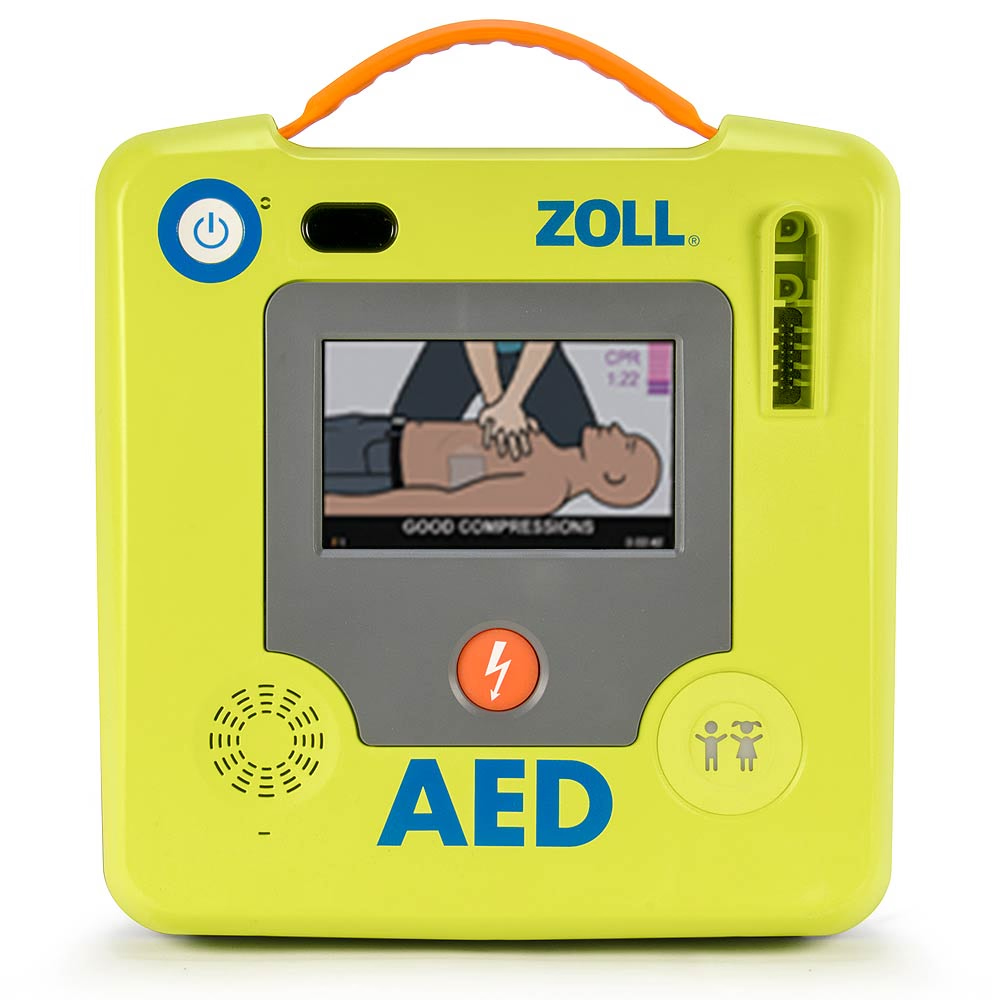
- Medical care: The Medical Lead coordinates CPR and AED application. Confirm that the AED powers on, pads are placed correctly, and the team continues compressions following prompts.
- Accountability: At assembly areas, the Accountability Lead conducts roll calls using rosters and visitor logs, reports missing persons to Incident Command, and prevents reentry.
- Stabilization: Work through injects, such as an unexpected blocked exit, and observe problem solving. Maintain radio discipline and use plain language.
- All-clear and recovery: When objectives are met, the Incident Commander declares an all-clear. Coordinate an orderly reentry and begin hot debriefs while memory is fresh.
Communication tip: Use plain, specific language for instructions. Avoid codes or jargon so everyone understands quickly, including visitors and contractors.
Capture data rigorously
Assign observers to time critical moments: alarm to first movement, 911 dialed, AED arrived on scene, first shock advised, first compressions, last person out, headcount complete, and all-clear. Note bottlenecks, equipment issues, and any confusion about roles. Photographs of assembly areas and exit points can help illustrate findings for your after-action review.
Keep it safe and respectful
Remind everyone this is a drill. Do not simulate injuries with behavior that could be mistaken for a real medical emergency without clear markings and controller supervision. Allow participants to opt out if they have medical or psychological concerns. If weather or operations create unexpected risk, pause and reschedule.
Measuring Performance, Debriefs, and Continuous Improvement
What gets measured gets managed. Use objective data to validate strengths and identify gaps. Then convert findings into a structured improvement plan with owners and due dates. Repeat the cycle until performance is consistent across shifts and locations.
Set performance targets and track trends
- Speed: time to alarm, time to 911, time to first compression, time to AED on scene, time to headcount.
- Coverage: percentage of staff who received notifications, number of areas swept, and roster match at assembly areas.
- Compliance: exits kept clear, doors closed, no reentry violations, PPE used correctly in relevant scenarios.
- Quality: clarity of radio traffic, adherence to procedures, and leadership handoffs.
Standards insight: ISO 45001 calls for testing emergency preparedness at planned intervals and evaluating effectiveness, then updating processes as part of continual improvement.
Conduct structured debriefs
Begin with a short hotwash immediately after the drill at both the command post and assembly areas. Capture what went well, what surprised people, and what needs change. Within a few days, hold a formal After Action Review with role holders and key stakeholders. Review timelines, photos, and observer notes. Document root causes rather than symptoms. For example, a delayed AED may reflect unclear signage or a cabinet alarm that people hesitate to open.
Build a corrective action plan
Translate findings into a Corrective Action Plan that includes a concise action, an owner, a due date, and a verification method. Examples include adding evacuation route signs where congestion occurred, relocating an AED for faster access, replacing aging radio batteries, or revising the 911 call script. Track actions to closure and brief leadership on progress. Update your Emergency Action Plan, floor maps, and training content to reflect changes, and then re-test the areas that changed.
Special Considerations: Multi-Site, Accessibility, and Wellbeing
Every workforce is different. Tailor drills so they work for every person and every shift. Think beyond office hours and typical workers to include contractors, remote staff, and visitors. The goal is a plan that functions on a busy Tuesday and at 2 a.m. on a holiday weekend.
Plan inclusively and accessibly
- Identify people who may need assistance during evacuation and pre-assign buddies or refuge plans.
- Provide materials in multiple languages where needed and use pictograms on maps and signs.
- Use visual alerts as well as audible alarms for people with hearing loss, and ensure strobe locations are adequate.
- Designate areas of refuge on upper floors and coordinate procedures with local fire services.
Visitors and contractors require special handling. Tie your visitor sign-in to headcounts and ensure contractor supervisors brief their teams on alarms, routes, and assembly areas before work starts. Include night shift, weekend, and holiday drills in your annual schedule so everyone practices.
Coordinate across locations and work modes
For multi-site companies, standardize core roles and metrics but allow site-specific procedures. Share best practices between facilities. For hybrid or remote teams, run table-top exercises that test leadership decision making and communication trees, and verify that contact information is current. Use digital muster tools or QR-based roll calls if appropriate and approved by your data privacy policies.
Tip: Practice realistically but avoid startling or distressing scenarios. Announced drills with clear framing often produce better learning without unnecessary stress.
Strengthen equipment readiness
Equipment performs only if it is maintained and easy to find. Place AEDs so they can reach any victim within 3 minutes of brisk walking. Check batteries, pads, and status indicators according to the manufacturer schedule, and log inspections. Stock first aid and bleeding control kits near high-risk tasks and in common areas. Verify that cabinets, signage, and lighting make gear unmistakable. Keep spill kits, eyewash stations, and fire extinguishers accessible and inspected. Include these checks in your pre-drill walkthrough.
Conclusion
Effective emergency response is built on clarity, practice, and continuous improvement. When you set precise objectives, empower trained roles, design realistic scenarios, and measure what matters, every drill becomes a step toward a safer workplace.
Ready to elevate your program further? Explore MyAED for AEDs, cabinets and signage, bleeding control and first aid kits, and training supplies that support fast, confident responses. Our team can help you select the right equipment mix for your facility and provide guidance on maintenance schedules. Contact us to get your workplace fully drill ready.