


Churches and Nonprofits
Do Churches and Nonprofits Need an AED?
Generally, no. The federal law on emergency use of automated external defibrillators (AEDs), 42 U.S.C. § 238q, says it does not require an AED to be placed at any building or other location, and we have not found a federal or state law that requires an AED in every church, other house of worship or nonprofit. State law can require AEDs in particular kinds of places, and a nonprofit that owns that kind of place may be covered. Oregon, for example, requires AEDs at health clubs and in large public buildings, but its large-building rule does not apply to a building primarily used for worship. If you choose to have an AED, federal law gives civil immunity to people who use one in a perceived medical emergency, with limited exceptions.
Last reviewed October 8, 2026. Each legal statement is linked to its source below.
What the Law Says
Federal law. The federal law on emergency AED use, 42 U.S.C. § 238q, deals with civil liability (covered below). It states that it does not require that an AED be placed at any building or other location (§ 238q(c)(1)(A)).
State law. AED placement requirements come from state law and sometimes from local codes. We have not found a state law that requires an AED in every house of worship, but this guide does not survey every state and local code. Where a state requires AEDs, the law can cover a kind of place rather than a kind of organization. In Oregon, for example:
- ✓Health clubs (ORS 431A.450): the owner of a health club must have at least one AED on the premises at all times. A health club is an indoor facility whose primary purpose is offering exercise or athletic activities for a fee, with 50 or more employees, patrons or members there on a regular business day. This health club rule does not apply to a facility owned by a hotel (ORS 431A.450(3)).
- ✓Places of public assembly (ORS 431A.455): notwithstanding the hotel exception in ORS 431A.450(3), the owner of a place of public assembly must have at least one AED on the premises. The law covers a single building with 50,000 square feet or more of indoor floor space where the public congregates or business is conducted, and where at least 50 individuals congregate on a normal business day.
- ✓Worship buildings are exempt from that rule: the public assembly requirement does not apply to a building primarily used for worship or education associated with worship (ORS 431A.455(4)).
Neither Oregon section has an exception for nonprofits. If your organization runs a school, child care program, fitness facility, camp or large public building, check your state's rules for that kind of place, and check any local building or fire code. Our AED requirements by state pages are a starting point.
Liability Protection
Under 42 U.S.C. § 238q(a), a person who uses or attempts to use an AED on a victim of a perceived medical emergency is immune from civil liability for harm resulting from that use. The person or organization that acquired the AED is also immune, unless the harm was due to its failure to:
- ✓Notify local emergency response personnel or other appropriate entities of the AED's most recent placement within a reasonable time after placing it.
- ✓Properly maintain and test the AED.
- ✓Provide appropriate training to an employee or agent who used the AED, unless that person was not someone who would reasonably have been expected to use it, or there was not a reasonably sufficient time to train them.
The immunity does not apply to harm caused by willful or criminal misconduct, gross negligence, reckless misconduct or a conscious, flagrant indifference to the victim's rights or safety. It also does not apply to a licensed or certified health professional using the AED within the scope of their license and employment, or in certain cases involving health care providers (§ 238q(b)). Where a state has its own statute or regulation giving AED immunity to a class of persons, the federal rule does not override it for that class (§ 238q(c)(1)(B)), so check your state's Good Samaritan and AED laws too.
Where to Place the AED
- ✓Put it somewhere central and visible near where people gather, such as the main worship space, fellowship hall or main entrance, not in a locked office.
- ✓Mount it in a wall cabinet or bracket with a sign, so visitors and new volunteers can find it.
- ✓If your campus has several buildings or floors, or you run off-site camps, trips or sports, plan how an AED will reach each of them.
- ✓Tell your local emergency medical services agency where the AED is. Federal immunity for the organization that acquired the AED depends partly on notifying local emergency response personnel of its placement.
- ✓If you run a nursery or children's programs, ask about child pads or a child mode for the model you choose.
Training and a Response Plan
- ✓Choose staff and regular volunteers who are present at services and events, such as ushers, greeters, safety team members and nursery and youth leaders, to complete a nationally recognized CPR and AED course and keep it current.
- ✓Write a short plan: who calls 911, who brings the AED, who starts CPR and who meets the ambulance crew at the door.
- ✓Practice the plan. An AED trainer lets volunteers rehearse without using the real device.
MyAED sells AEDs and supplies. We do not run CPR classes or issue training certificates.
Keep It Ready
- ✓Check the AED's status indicator as often as the manufacturer's instructions say, and keep a simple log of each check.
- ✓Pads and batteries have expiration dates. Replace them before they expire, and replace the pads after they are used.
- ✓Federal immunity for the organization that acquired the AED depends partly on properly maintaining and testing it.
- ✓Free AED program: for every AED you register with us, we track its pad and battery expiration dates at no charge. You can add AEDs bought elsewhere, too. Register your AED.
AEDs for Churches and Nonprofits
The federal and Oregon provisions cited on this page do not name a brand or model of AED. Check any other requirements that apply to your building. These AEDs are designed for public-access use, with voice prompts that guide the rescuer. Each card shows the current price, the same price you pay in the cart.

Philips HeartStart OnSite AED
Automated External Defibrillator Designed for the ordinary person in the extraordinary moment, Phi...

ZOLL AED PLUS
The ZOLL AED Plus features Real CPR Help technology that provides real-time CPR feedback on compress...

HeartSine Samaritan PAD 350P & 360P
The semi-automatic HeartSine samaritan PAD 350P AED and fully automatic HeartSine samaritan PAD 360P...
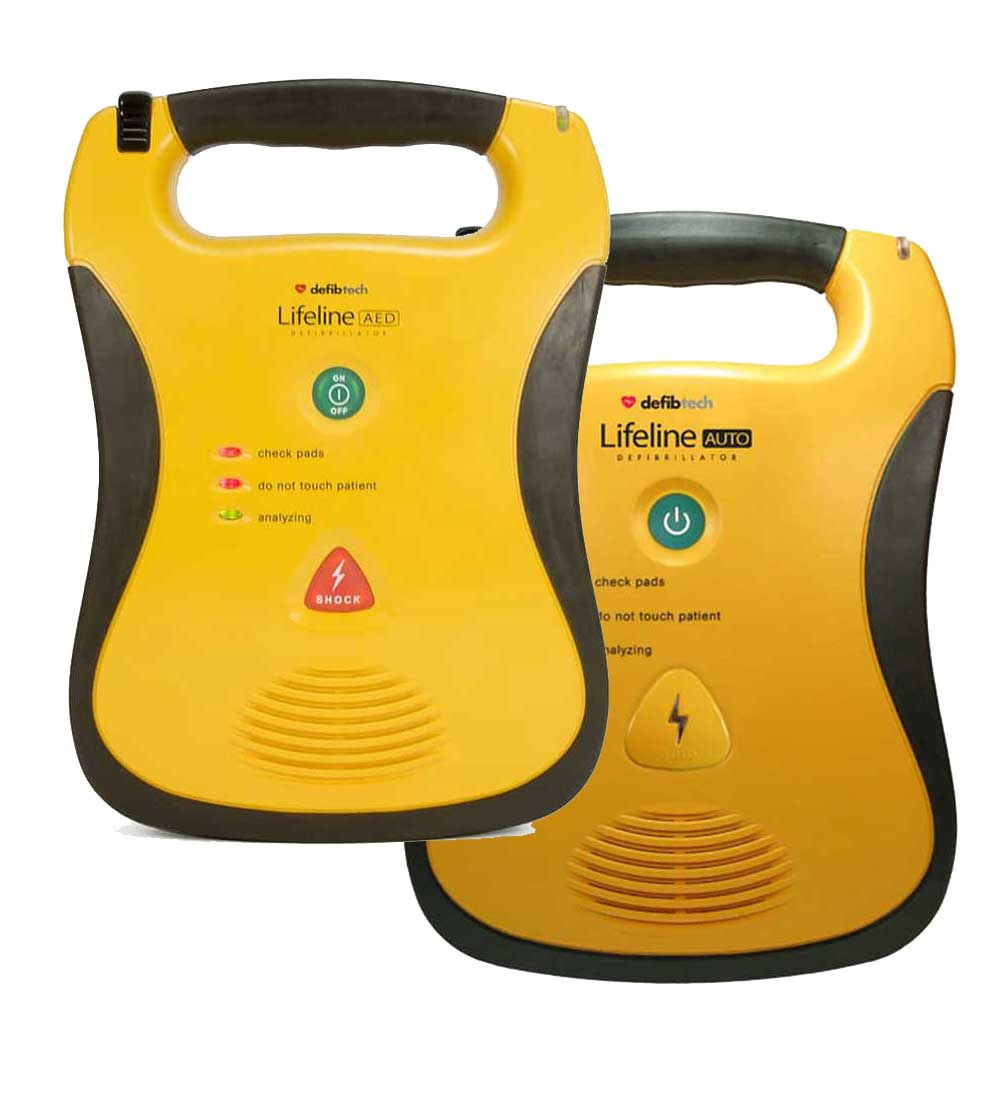
Defibtech Lifeline AED
The original Defibtech AED includes all mission critical features necessary to provide the most adva...
A cabinet and a sign help people find the AED, and a trainer helps volunteers practice. Child pads fit one specific AED model, so check the product page before you order.

HeartSine Wall Cabinet With Alarm
Compact wall-mount AED cabinet with built-in door alarm and 2 keys. Designed for HeartSine Samaritan...

Philips HeartStart AED Signage Bundle
The Philips AED Signage Bundle enhances the visibility and accessibility of Automated External Defib...
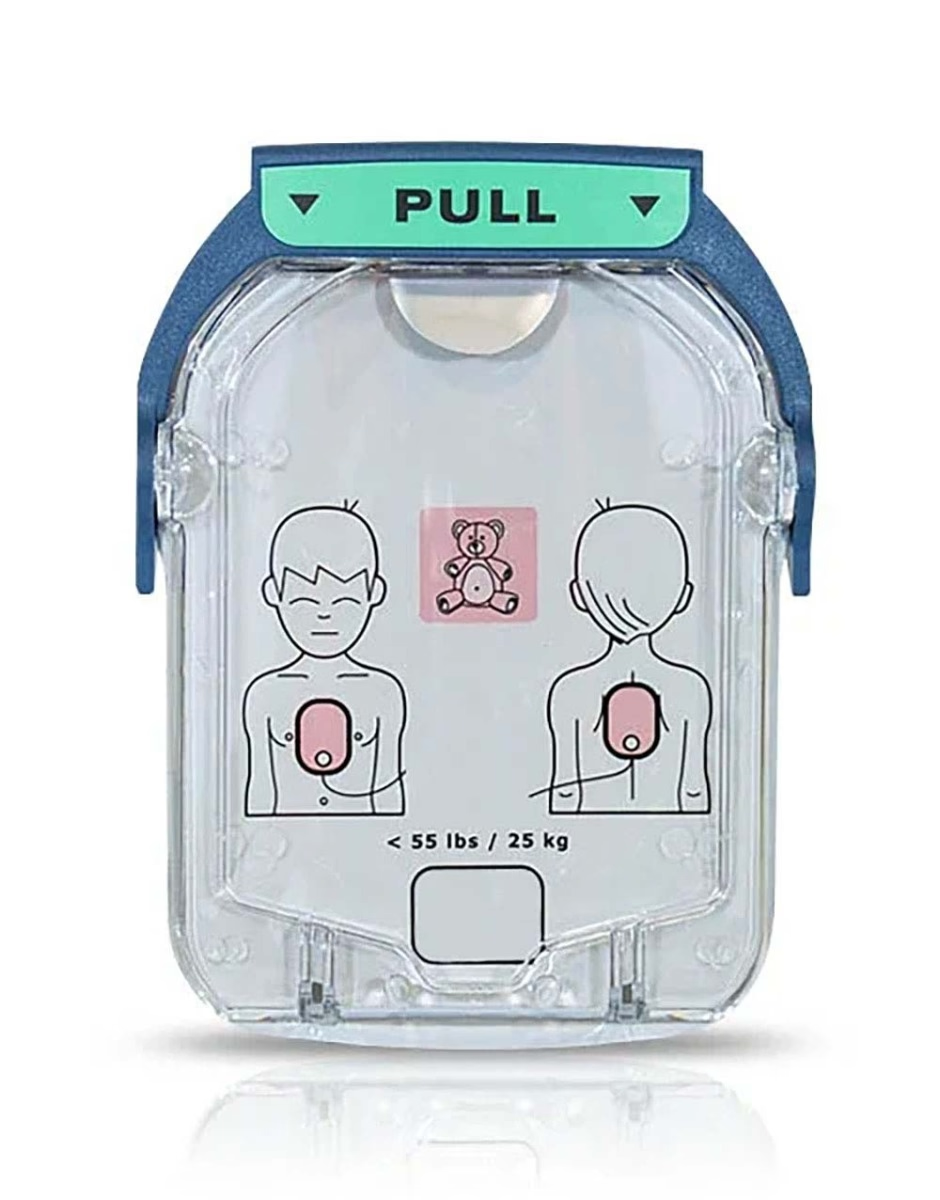
Philips HeartStart OnSite Infant/Child SMART Pads Cartridge
The Philips HeartStart OnSite Infant/Child SMART Pads Cartridge (M5072A) enables the OnSite AED to s...

HeartSine Samaritan PAD Trainer
The easy-to-use HeartSine samaritan PAD Trainer with remote control guides users through simulated a...
Buying for several buildings, or with donated or grant funds? Request a quote and ask us about grant options. See also our AEDs for churches page.
Frequently Asked Questions
Is a church legally required to have an AED?
Generally, no. The federal AED law does not require an AED at any building, and we have not found a federal or state law that requires an AED in every house of worship. Oregon's AED requirement for large public buildings expressly does not apply to a building primarily used for worship. Check your state law and any local building or fire code.
Are nonprofits exempt from AED laws?
Not automatically. Where a state law requires AEDs at a kind of place, such as a health club or a large public building, it can apply to the owner whatever its tax status. Oregon's health club and public building rules, for example, have no nonprofit exception.
Can our church be held liable if a volunteer uses the AED?
Federal law (42 U.S.C. § 238q) gives civil immunity to a person who uses or attempts to use an AED on a victim of a perceived medical emergency. The organization that acquired the AED is also immune, unless the harm was due to its failure to notify local emergency responders of the AED's placement, to maintain and test it, or to train an employee or agent expected to use it. The immunity does not cover gross negligence or willful misconduct, and state AED immunity laws apply where a state has them.
Who should be trained to use the AED?
Staff and regular volunteers who are present at services and events, such as ushers, greeters, safety team members and nursery and youth leaders. Have them complete a nationally recognized CPR and AED course and keep it current.
How do we keep the AED ready?
Check the status indicator as often as the manufacturer's instructions say, and replace pads and batteries before the expiration dates printed on them. For every AED you register in our free AED program, we track its pad and battery expiration dates at no charge.
Are there grants for church or nonprofit AEDs?
We do not list specific grant programs here. Ask us about grant options when you request a quote.
Sources
- 42 U.S.C. § 238q, Liability regarding emergency use of automated external defibrillators (United States Code, 2024 edition)
- Oregon Revised Statutes chapter 431A (2025 edition): ORS 431A.450 (health clubs) and ORS 431A.455 (places of public assembly)
Laws change; confirm with your state. This page summarizes federal and state law for general information and is not legal advice. Local building and fire codes can add requirements. Check with your state agency, local EMS agency or attorney before relying on it.
Related: AEDs for Churches · AED Requirements by State · Free AED Program